Categorías
Lección 7 - 10

Lección 7

This is Angeles. She‘s a dentist and she lives and works in Valencia, Spain. On Mondays and Wednesdays Angeles gets up at 7 o’clock and goes swimming. She has breakfast in a bar and goes shopping. She never gets up late. She usually listens to the radio and sometimes she reads the newspaper.

She has lunch at 2 o’clock and goes to work by bus in the afternoon. She has a car but she doesn’t drive to work.

Angeles gets home late, usually at 9 or 10 o’clock. She has dinner and she sometimes plays ‘spider’ on her computer. She usually goes to bed at 12 o’clock. Sometimes she reads a book in bed.

Lee el texto otra vez y busca los verbos. Escríbelos en el siguiente cuadro. Sigue los ejemplos.


______________________________________________________


 lee el texto de nuevo utilizando el cuadro de ayuda para conocer el significado de las palabras difíciles.

This is Angeles. She’s a dentist and she lives and works in Valencia, Spain. On Mondays and Wednesdays Angeles gets up at 7 o’clock and goes swimming. She has breakfast in a bar and goes shopping. She never gets up late. She usually listens to the radio and sometimes she reads the newspaper.

She has lunch at 2 o’clock and goes to work by bus in the afternoon. She has a car but she doesn’t drive to work.

Angeles gets home late, usually at 9 or 10 o’clock. She has dinner and she sometimes plays ‘spider’ on her computer. She usually goes to bed at 12 o’clock. Sometimes she reads a book in bed.

goes swimming = va a nadar
goes shopping = va a la compra
never = nunca
usually = normalmente
but = pero
sometimes =a veces
late = tarde
in bed =en la cama


______________________________________________________

Las siguientes frases no son correctas. Corrígelas mirando el texto anterior. Sigue los ejemplos.

Ejemplos

Angeles has breakfast at home.
Angeles desayuna en casa.
Angeles doesn’t have breakfast at home. She has breakfast in a bar.
Angeles no desayuna en casa. Ella desayuna en un bar.
She drives to work
Ella conduce para ir al trabajo.
She doesn’t drive to work. She goes to work by bus.
Ella no conduce para ir al trabajo. Va al trabajo en autobús.
=> Angeles works in Barcelona
Angeles doesn’t  in Barcelona. She  in Valencia.
=> She goes swimming on Tuesdays and Thursdays
She
=> She listens to the television
=> She has lunch at 12 o’clock
=> She goes to work by car
=> She goes to work in the morning
=> She plays ‘Tomb Raider’ on her computer
=> She reads a magazine in bed  (magazine=revista)


_____________________________________________________

Lee otra vez las respuestas del ejercicio anterior. Escúchalas y repítelas. Intenta imitar la entonación.

  • Angeles doesn’t work in Barcelona. She works in Valencia.
  • She doesn’t go swimming on Tuesdays and Thursdays. She goes swimming
  • on Mondays and Wednesdays.
  • She doesn’t listen to the television. She listens to the radio.
  • She doesn’t have lunch at 12 o’clock. She has lunch at 2 o’clock.
  • She doesn’t go to work by car. She goes to work by bus.
  • She doesn’t go to work in the morning. She goes to work in the afternoon.
  • She doesn’t play ‘Tomb Raider’ on her computer. She plays ‘Spider’ on her computer.
  • She doesn’t read a magazine in bed. She reads a book.


____________________________________________________


PRESENT SIMPLE  – Presente Indicativo

Positivo + Negativo –
I
You
He
She
We
They
work
work
works
works
work
work
don’t work
don’t work
doesn’t work
doesn’t work
don’t work
don’t work
Preguntas con respuesta corta Respuestas cortas
¡Cuidado!
Yes, I do
NO X yes, I work X
Does she speak English?
Do we work on Saturday?
Do they work on Saturday?
Does he work on Saturday?
No, she doesn’t. / Yes, she does.
Yes we do. / No, we don’t.
Yes they do. / No, they don’t.
Yes he does. / No, he doesn’t.
Más preguntas When?

What?

Where?

What time does she have lunch? ¿A qué hora come ella?
Where does she live? ¿Dónde vive ella?
When does she go to work? ¿Cuándo va al trabajo?
What does she read in bed? ¿Qué lee ella en la cama?


______________________________________________________

RECUERDA

  • En las frases afirmativas del presente simple normalmente no se usa el auxiliar ‘do’ o ‘does’ delante del verbo. Sin embargo, la tercera persona añade una ‘s’.You live in Valencia. He lives in London. -> Tú vives en Valencia. Él vive en Londres
  • En las preguntas y negaciones se utiliza el auxiliar ‘do’ / ‘don´t’ (‘does’ / ‘doesn´t’ para la tercera persona).Do you live in Valencia? / Does he live in London?
    No, I don’t. / No, he doesn’t
  • Con el verbo ‘To be’ (ser, estar) no se utiliza el auxiliar ‘do’ / ‘does’Observa la diferencia:

    Where does she live? / She lives in Valencia -> ¿Dónde vive ella? / Ella vive en Valencia
    Where is she from? / She is from London -> ¿De dónde es ella? / Ella es de Londres


___________________________________________________

Never, usually y sometimes


Las palabras never, usually y sometimes (nunca, normalmente, a veces) son adverbiales (adverbios de frecuencia). Normalmente van justo delante del verbo.
She never gets up late. / Ella nunca se levanta tarde.
I 
usually read the newspaper in the morning. / Normalmente leo el periódico por la mañana.
We 
sometimes listen to the radio. / A veces escuchamos la radio.

Lee las siguientes frases y escribe el adverbio en el sitio correcto (justo delante del verbo). Sigue el ejemplo.

Ej. I read the newspaper (never) I never read the newspaper.

1. I work on Sundays (never)
2. He goes swimming on Saturdays. (sometimes)
3. We have dinner at home. (usually)
4. I go to work by bus. (never)
5. She has lunch in a bar. (sometimes)
6. I read in bed. (never)
7. They go swimming in the morning (usually)
8. I have breakfast in a bar (sometimes)
9. I get up at 6 o’clock. (never)
10. We go shopping on Saturdays. (usually)

_____________________________________________________

 Traduce las siguientes frases al español siguiendo el ejemplo.

Ej. I never work on Sundays -> Nunca trabajo los domingos.

1. He sometimes goes swimming on Saturdays.
2. We usually have dinner at home.
3. I never go to work by bus.
4. She sometimes has lunch in a bar.
5. I never read in bed.
6. They usually go swimming in the morning.
7. I sometimes have breakfast in a bar.
8. I never get up at 6 o’clock in the morning.
9. We usually go shopping on Saturdays.

Relaciona las palabras del grupo A con las del grupo B. Sigue el ejemplo.

A

B

1. have
2. drive
3. play 
4. read
5. get up 
6. listen

____________________________________________________

Relaciona las palabras del grupo A con las del grupo B.


A

B

1. work
2. speak 
3. go 
4. play
5. have
6. read


______________________________________________________


Relaciona las preguntas con las respuestas. Sigue el ejemplo.

A B
1. What time do you get up?
2. How old are you?
3. Where do you live? 
4. What’s this in English?
5. Who’s your teacher? 
6. How many brothers do you have?
7. When do you go swimming?


____________________________________________________


 lee los siguientes adjetivos. Mira los dibujos.
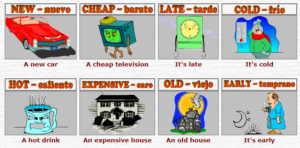
Escribe el adjetivo contrario. Sigue el ejemplo.

expensive
cold
late
old


 Elige el adjetivo correcto en las siguientes frases. Sigue el ejemplo.

It’s usually  in New York in December

1. 6 o’clock in the morning is 
2. A Ferrari is a/an 
 car.
3. In August Spain is very 

4. My father is 78. He’s an/a 
 man.
5. In Spain, people usually have a 
 dinner.
6. The coffee in Paris is very 

7. India is a 
 country to visit.
8. My son has a/an 
 computer.

August = agosto
very = muy
people = gente, la gente
country = país
to visit = visitar


Elige la mejor palabra para hacer cada pregunta. Sigue el ejemplo.

 is your name?

 do you live?
 are you?.
 time do you go to work?
 do you usually have lunch?
 does she read in bed?
 does your husband get home?
 do you do after work?
 brothers and sisters do you have?
 do you get up at 6 o’clock?
 music do you like?
 old are you?
 my new radio?

When…? = ¿Cuándo…?
Why…? = ¿Por qué…?
What…? = ¿Qué…?
Where…? = ¿Dónde…?
How…? = ¿Cómo…?
How many…? = ¿Cuantos…?


Categorías
Lección 7 - 10

Lección 8

House

____________________________________________________
 

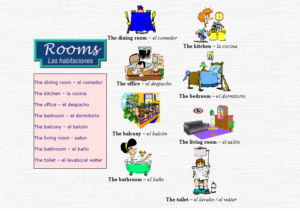
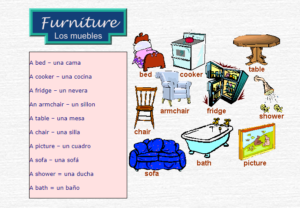
Relaciona las siguientes imágenes con su correspondiente término.


______________________________________________________


There is / There are
PositivoThere’s a sofa. (singular) Hay un sofá
There are four chairs. (plural) Hay cuatro sillas
NegativoThere isn’t a radio in the bathroom.
There 
aren’t any chairs in the bedroom
PreguntaAre there any pictures in the kitchen?
Is there a shower in the bathroom?
RespuestaYes, there are. /No, there aren’t.
Yes, there is./No, there isn’t

______________________________________________________

Elige el número correcto para cada frase. Sigue el ejemplo y utiliza el cuadro de ayuda para las palabras que desconozcas.

5 / 60 / 10 / 24 / 9 / 26 / 7 / 11 / 2

 There are  players in a basketball team – (hay 5 jugadores en un equipo de baloncesto)

There are  days in a week.
There are  players in a football team.
There are  lessons in Manoli’s English course.
There are  letters in the English alphabet.
There are  minutes in an hour.
There are  bedrooms in Manoli’s flat.
There are  planets in our solar system.
There are  hours in a day.
week = semana
letters = letras
alphabet = alfabeto
planet = planeta
solar system = sistema solar


_____________________________________________________

ANY

Normalmente utilizamos any para las preguntas y frases negativas.

Are there any chairs in the bedroom? ¿Hay sillas en el dormitorio?
There isn’t any beer! ¡No hay cerveza!


Mira bien los dos fotos. Hay ocho diferencias entre ellas. Hay ocho cosas en la foto A que no están en la foto B.
Escribe las cosas que faltan en la foto B siguiendo los ejemplos

A B

1. 
2. 

3. 

4. 

5. 

6. 

7. 

8. 


_____________________________________________________

Completa las frases con las palabras más adecuadas. Sigue el ejemplo.

there is / there isn’t / is there? / there are / there aren’t / are there?

Ej.  a train at 6 o’clock? / (¿Hay un tren a las 6?)

1.  any trains to Cardiff this morning?
2.  a train at 8 o’clock.
3.  any trains to Ipswich on Sunday.
4.  a bank near here?
5.  seven days in a week.
6.  any chairs in the bedroom.
7.  a beer in the fridge?
8.  two sofas in the living room.
Categorías
Lección 7 - 10

Lección 9

Escribe frases relacionando a los personajes famosos con sus profesiones. Sigue el ejemplo.

Who was Humphrey Bogart?  

  • Politician
  • Singer
  • Singer
  • Nun (monja)
  • Actress
  • Writer
  • Singer
  • Singer
  • Naturalist
  • Actor
  • Actor
1. Who was Charles Darwin?
2. Who was Oscar Wilde?
3. Who was Jane Austen?
4. Who was Winston Churchill?
5. Who was Mother Teresa?
6. Who was Kurt Cobain?
7. Who was Marlene Dietrich?
8. Who was Aaliah?
9. Who was Ella Fitzgerald?


_______________________________________________________

Pon was o were en los espacios en blanco.

Present Simple Past Simple
What is your name? When  you born?
She is a dentist.
He 
is Spanish.
She  a singer.
He  born in 1899

_______________________________________________________

Estudia el verbo To Be en pasado (‘Past Simple’)

+ POSITIVO
I
He
She
It
–
was
\
born in London
/
You
We
They 
–
were
– NEGATIVO
I
He
She
It
–
wasn’t
\
born in London
/

wasn’t = was not

weren’t = were not


You
We
They

–

weren’t


  ? LAS PREGUNTAS
    LAS RESPUESTAS
Was
–
I
he
she
it
\
born in London?
/
Yes, you were
No, you weren’t
Yes, he / she / it was
No, he / she / it wasn’t
Were
–
you
we
they
Yes, I was
No, I wasn’t
Yes, we / they were
No, we / they weren’t

_______________________________________________________

Escribe las siguientes frases en pasado (PAST SIMPLE). Sigue los ejemplos.

Ej. 1.
I‘m married. (I am married) Estoy casado/a.  I was married. Estaba casado/a

Ej.2.
They are actors. Ellos/Ellas son actores. They were actors. Ellos/Ellas eran actores.

1. Today is Friday. Yesterday 
2. I’m a secretary.  
3. He isn’t a footballer. 
4. They are famous. 
5. How much is this T-shirt? 
6. George Bush is President of the USA. 
7. It’s a new sofa.  
8. Are there any pictures on the walls? 
9. It’s hot today. 
10. We aren’t in Buenos Aires. 

_______________________________________________________

Escribe el adjetivo contrario. Sigue el ejemplo.

horrible / single / small / bad

married
big
lovely
good

_____________________________________________________

 Elige el adjetivo correcto en las siguientes frases. Sigue el ejemplo.

Ej. Luis and Manoli are 

1. Brazil is a  country.
2. Mother Teresa was a  person.
3. Denmark is a  country.
4. Brad Pitt was , but now he’s  to Jennifer Aniston.
5. Thank you for the  present.
6. English food is !

single = soltero
person = persona
present = regalo
food = comida

_______________________________________________________

Lee el siguiente formulario que ha rellenado Manoli.

Surname GARCÍA    Mr. / Mrs. / Ms.
registration form =
formulario de matrícula
surname = apellido
first name = nombre
date of birth = fecha de nacimiento
postcode = código postal
signature = firma
First name MANOLI
Date of Birth 15-12-1958
Home Address 67 El Pez Famoso, Valencia, SPAIN
Postcode 46029
Telephone Number Home 96 23386554   Work: 23685942
Mobile 197533260
E-mail address manoli@pezmail.com
Nationality Spanish
Married/Single Married
Profession Housewife
Date 21-11-2004

 Ahora rellena el formulario con tus datos.

Surname     Mr. / Mrs. / Ms.
First name
Date of Birth
Home Address
Postcode
Telephone Number Home    Work: 
Mobile
E-mail address
Nationality
Married/Single
Profession

Date

______________________________________________________

would like 

  • Utilizamos would like para pedir cosas.– I’d like a beer, please. -> Quisiera una cerveza por favor.
    – We’d like two coffees. -> Queríamos dos cafés.

*(‘d = would)

  •  También podemos utilizar would like para ofrecer cosas.– Would you like a drink? -> ¿Te apetece beber algo?
    – Would you like some more bread? -> ¿Te apetece un poco más de pan?
  •  Utilizamos like para hablar de las cosas que nos gustan y de las que disfrutamos.– I like beer. -> Me gusta la cerveza. (siempre)
    – I like playing tennis. -> Me gusta jugar al tenis. (siempre)
    – What do you like doing? -> ¿Qué te gusta hacer?
  • Would like es paracido a want, pero utilizamos would like con gente que no conocemos y para ser más cortés y educado.– I want some more cake! -> ¡Quiero más pastel!
    – I’d like some more cake, please. -> Me gustaría un poco más de pastel por favor.


Categorías
Lección 7 - 10

Lección 10

Lee y memoriza:

_______________________________________________________

Manoli está en un restaurante y quiere pedir comida. Lee y elige la comida que pide de la carta.

TRASCRIPCIÓN

– Hello. Are you ready to order?
– I’m sorry?
– What would you like Madam?
– Oh! I’d like vegetable soup.
– Vegetable soup. And what would you like for the main course?
– I’m sorry? Please speak slowly.
– And what would you like for the main course?
– I’m sorry, I don’t understand.
– Would you like anything else?
– Ah! Yes, I’d like chicken please.
– With chips or salad?
– With salad.
– Okay, roast chicken and salad. What would you like to drink madam?
– Mineral water, please.
– Okay. Thank you.

 Vegetable soup
 Green salad
 Prawn cocktail

 Fish and chips
 Roast chicken with chips
 Roast chicken with salad
Fillet steak with roast potatoes     

AYUDITA
********************************************
What would you like? = ¿Qué le gustaría?
I’m sorry? = ¡perdone…!
Please speak slowly = Por favor, hable despacio
I’m sorry, I don’t understand = Lo siento, no entiendo
Would you like anything else? = ¿Le gustaría algo más?

______________________________________________________

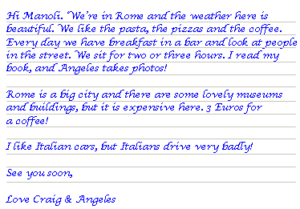
Craig ha enviado una postal a Manoli. Lee el texto, escucha y contesta las preguntas.

1. Where is Craig?

2. Does he like the coffee?

3. Where does Craig have breakfast?

4. What does Craig read?

5. How much is a coffee?

AYUDITA
********************************************
weather = tiempo (atmosférico)
every day = todos los días
to look at the people = mirar a la gente
the street = la calle
to sit = sentarse
buildings = edificios
take photos = hacer fotos
drive badly = conducir mal
see you soon = hasta la vista

_____________________________________________________

Manoli quiere enviar un e-mail a Craig pero tiene algunas dudas. Elige la opción correcta entre las posibles.

Hi Craig

Thank  for your lovely postcard. It’s hot here in Valencia and I go swimming every day. I’m happy you like Rome.  you speak Italian now?

Please  photos of everything in Rome. I’d like to see  photos of the buildings, the streets and the people.

 fine here. I get up early and go to  late. I study  every day. We have a new computer. It’s wonderful.

See you ,

Manoli.

AYUDITA
********************************************
I’m happy = estoy feliz
I’d like to see = me gustaría ver
buildings = edificios
I study
 = estudio
wonderful = maravilloso, estupendo

_______________________________________________________

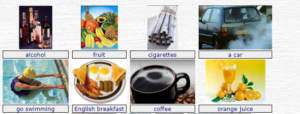
Mira las imágenes y decide cuáles representan cosas saludables (healthy) y cuáles pueden resultar nocivas para la salud (unhealthy).

Ahora escribe las palabras en la lista adecuada.


_______________________________________________________

Ahora Lee a Craig  y a Angeles  y elige quién lleva una vida más sana.

Craig

I get up late, usually about 9 o’clock. I have a big English breakfast; eggs, bacon, tomatoes, sausages, beans, bread and butter, jam and tea.

I don’t do any exercise and I smoke two packets of cigarettes every day.

I drive to work. I have a big lunch with two or three beers, and I usually have a sandwich or some biscuits in the morning. I love coffee and I drink about eight cups every day.

I finish work at 6. After work I sometimes go to the pub with friends and have four or five beers and one or two whiskeys. After the pub we usually have dinner in a Chinese or Indian restaurant. Sometimes we get a takeaway and eat it at home.

We watch TV after the pub, drink more beers and eat our takeaway dinner on the sofa.


Angeles

I sleep eight hours every night. I always get up early, about 7 o’clock and I go jogging. I get up early on Sundays too, but at the weekends I don’t go jogging, I go swimming.

I have orange juice and cereal for breakfast. I don’t drink tea or coffee.

I go to work by bicycle every day. I sometimes have salad for lunch or fish with vegetables or rice.

I always buy fruit and vegetables because I don’t eat meat. I eat fruit every day and I don’t smoke. I hate cigarettes. I never drink alcohol, but I drink a lot of water. I’m very healthy!

____________________________________________________

Repite la pronunciación de los siguientes verbos en tercera persona.

He drinks beer.
She sleep
s eight hours.
He smoke
s.
She eat
s vegetables.
She goes swimming.
He do
esn’t get up early.
She ha
s a bicycle.
He lov
es coffee.
She do
es exercise.
She buy
s fruit.
He watches TV.
He finish
es work at 6.

Elige las frases que mejor reflejan tus hábitos de vida.

  1. I smoke. / I don’t smoke.
  2. I drive to work. / I don’t drive to work./I sometimes drive to work.
  3. I usually get up late. / I usually get up early./I never get up early.
  4. I do exercise. / I never do exercise./ I sometimes do exercise.
  5. I sometimes get a takeaway. / I never get a takeaway.
  6. I sometimes go jogging / I never go jogging./I go jogging every day.
  7. I love whiskey. / I never drink whiskey / I sometimes drink whiskey.
  8. I eat healthy food. / I don’t eat healthy food.
  9. I like swimming. / I don’t like swimming.
10. I love fruit and vegetables. / I hate fruit and vegetables.
11. I watch TV every day. / I don’t usually watch TV. / I sometimes watch TV.
12. I sometimes drink alcohol. / I never drink alcohol./I drink alcohol every day.