Categorías
Lección 4 - 6

Lección 4

The family

Mira la foto de la familia de Manoli. Lee el texto y escucha. 
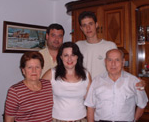
This is Manoli’s family. They are from Valencia, Spain.

Manoli has a husband and his name’s Luis. Their house is in Valencia. Luis and Manoli have a son. His name’s Rubén and he’s 18. Rubén is a student at university. Rubén’s university is in Valencia.

Manoli’s mother is Emilia . She’s 77. Manoli’s father is Felipe. He’s 78. Emilia and Felipe are Manoli’s parents. They have a house in Valencia.


 La ‘s posesiva

Manoli‘s family = La familia de Manoli

‘s se usa normalmente para expresar posesión.

Manoli’s mother = La madre de Manoli

– ¡Cuidado!. No lo confundas con la contracción de ‘is’.

His name‘s Rubén (name is) = Su nombre es Rubén.
He‘s 18 (he is 18) = (Él) Tiene 18 años.

– Pero:

Rubén’s university = La universidad de Rubén.

AYUDITA

family = familia
husband = marido
son = hijo
student = estudiante
mother = madre
father = padre
parents = padres
have = tienen
has = tiene
house = casa

_____________________________________________


Contesta las preguntas sobre el texto anterior.

1. Is Luis Manoli’s husband? 
2. Is Rubén a teacher? 
3. Where is Manoli’s house? 
4. Where is Rubén’s university? 
5. What’s Manoli’s father’s name? 
6. What’s her mother’s name? 
7. How old is Manoli’s father? 
8. How old is her mother? 
where? = ¿dónde?


______________________________________________

Craig’s family

Lee el texto

This is Craig’s family. They are from London, England.
Craig has a sister. Her name’s Stephanie and she’s 49. Craig’s mother is 73. Her name’s Frances. His father’s 72. His name’s Harry. They have a big house in Spain.
big = grande

Completa la siguiente tabla con la información del texto anterior sobre la familia de Craig.

NAME AGE
Craig’s mother 
Craig’s father
Craig’s sister
¿Has observado que el adjetivo (big) precede al nombre?

En inglés suele ser habitualmente así, mientras que en español es generalmente al revés.


Big
house ->Casa grande.
  Red car -> Coche rojo


_____________________________________________________


lee el texto.

My name’s Stephanie. I’m from London. I’m 49 and I’m a housewife.

My father’s name’s Harry. He’s 72. My mother’s name’s Frances, and she’s 73. Frances is Harry’s wife. They have a big house in Spain. Frances and Harry are my parents and I am their daughter. They have two children.

I have a brother. His name is Craig and he’s a teacher in Valencia. He’s 41. I’m Craig’s sister.

I’m married. My husband’s name is Terry and he has a good job.

AYUDITA

wife = mujer, esposa
parents = padres
sister
 = hermana
daughter = hija
children = niños
brother = hermano
husband = marido, esposo
good job= buen trabajo


Elige la palabra correcta para cada frase.

parents / children / brother / daughter / father / sister
mother / son / husband / wife

1. Frances is Harry’s 
2. Craig is Stephanie’s 
3. Terry is Stephanie’s 
4. Frances is Stephanie’s 
5. Craig is Harry’s 
6. Stephanie is Craig’s 
7. Stephanie and Craig are Frances and Harry’s 
8. Frances and Harry are Craig and Stephanie’s 
9. Stephanie is Frances and Harry’s 
10. Harry is Craig’s 


__________________________________________________

EL VERVO  » TO HAVE » (tener)

I  have   a house


He
She
It
has
We
You
They
have

Escribe las siguientes frases. Sigue el ejemplo

1. 
2. 
3. 
4. 
5. 
6. 
7. 
8. 

Elige ‘has’ o ‘have’ en las siguientes frases siguiendo el ejemplo.

Manoli  a son. His name’s Rubén

1. My wife  a good job.
2. I 
 a computer.
3. We 
 a house in the city.
4. They 
 an American car.
5. My sister 
 two dogs.
6. Craig 
 a sister.
7. Our house 
 five rooms.
8. They 
 a book.
9. Her daughter 
 three children.
10. We 
 a new phone.
the city = la ciudad
our = nuestro/a
rooms
 = habitaciones
new = nuevo


_________________________________________________

THE ALPHABET

Las letras del alfabeto inglés y repitelas.

A B C D E F G H I J K L M N O P Q R S U V W X Y Z
Letra Fonética Pronunciación
A /eɪ/ [ei]
B /bi/ [bi]
C /si/ [ci]
D /di/ [di]
E /i/ [i]
F /ef/ [ef]
G /dʒi/ [yi]
H /eɪtʃ/ [eich]
I /aɪ/ [ai]
J /dʒeɪ/ [jei]
K /keɪ/ [kei]
L /el/ [el]
M /em/ [em]
N /en/ [en]
O /əʊ/ [ou]
P /pi/ [pi]
Q /kju/ [kiu]
R /ɑ(r)/ [ar]
S /es/ [es]
T /ti/ [ti]
U /ju/ [iu]
V /vi/ [uvi]
W /ˈdʌb(ə)l ju/ [dabliu]
X /eks/ [ex]
Y /waɪ/ [uai]
Z /zed/ [set]


A : Ant = hormiga, Aunt = tía, And = y

B: Beautiful = bonito, Beach = playa, Blue = azul

C : Cherry = cereza, Cloud = nube, Cat = gato

D: Dry = seco, Dog = perro,

E: End = fin, Elephant = elefante

F: Food = comida, Fish = pez, Fast = rápido

G: Good = bien, Glue = pegamento

H: Horse = caballo, Hug = abrazo

I: Indian = indio, Igloo = iglú

J: Journal= periódico, Jail = cárcel, Jam= mermelada

K: King = rey, Key = llave, Kiss = beso

L: Love = amor, Live = vida, Last = último

M: Mother = madre, Mouse = ratón, Married= casado

N: Night = noche, Nine = nueve, Nose = nariz

O:  Open = abierto, Other = otro

P: Pink = rosa, Power = poder

Q: Queen = reina, Question = pregunta

R: Reed = rojo, Rice = arroz, Rute = ruta

S: Star = estrella, Spring = primavera, Sport = deporte

T: Time = tiempo, Table = mesa

U: Umbrella = paraguas, Under = debajo

V: Verb = verbo, Volcano= volcán

W: Word = palabra, World = mundo

X: X-ray = radiografía, Xylophone = xilófono

Y: Young = joven, Yesterday = ayer, Yes = sí

Z: Zero = cero, Zoo = zoológico

___________________________________________________

HOW DO YOU SELL IT? (como se escribe eso?)

 ‘Spell’ tiene principalmente el sentido de ‘deletrear’.
Como habrás visto, a diferencia del español, en inglés las palabras tienen generalmente una pronunciación diferente a su forma escrita. Por ello suele emplearse el recurso de deletrear las palabras (sobre todo apellidos, lugares geográficos y términos que puedan resultar desconocidos) para identificarlas con certeza.

Escribe palabras en ingles

 1.  
2.  

3.  

4.  

5.  

6.  

7.  

8.  

9.  

10. 

Escribe el término equivalente en inglés de la siguiente relación de palabras. La primera letra ya está escrita para ayudarte.

 1. esposa, mujer
 2. hermano
 3. esposo, marido
 4. madre
 5. hijo
 6. hermana
 7. hijos
 8. padres
 9. hija
10. padre
PUNTO

El plural en inglés generalmente se forma añadiendo una ‘s’ al final de la palabra

brother -> brothers (hermano / hermanos)
 daughter -> daughters (hija / hijas)

Pero no siempre es así. En inglés, algunas palabras tienen un plural irregular.

wife -> wives (esposa / esposas)
son -> children (hijo / hijos)

Categorías
Lección 4 - 6

Lección 5

Do you speak Spanish?

Manoli sobre distintos idiomas.

– Manoli, do you speak Portuguese?
– No, I don’t.
– Do you speak French?
– A little.
– Do you speak German?
– No, I don’t.
– Do you speak Spanish?
– Yes, I do.
– Do you speak English?
– Yes, a little.
To speak = hablar
Do you speak… ?  = ¿hablas…?
A little = un poco
Don’t = do not (negativo)


A diferencia del español, en inglés, los gentilicios (nombres que expresan el origen geográfico) se escriben siempre con mayúscula.

Spain -> España -> 
I’m from Spain / Soy de España
 Spanish -> español -> I’m Spanish / Soy español
Italy -> Italia -> 
You are from Italy / Eres de Italia
Italian -> italiano -> 
You speak Italian / Hablas italiano

_______________________________________________________

Relaciona cada palabra con su imagen.

paella / tea / wine / beer / ice cream / swimming
dogs / rap music / chocolate (
choklet) / football


_____________________________________________________


What do you like?
¿Qué te gusta?

Escribe las siguientes palabras en el grupo correcto siguiendo el ejemplo.

chips / classical / pizza / rap / chocolate / pop / ice cream / swimming / beer
rock / tea / football / water / fruit / pasta / coffee / skiing / tango / rugby / coke

MUSIC FOOD DRINKS SPORTS

chips = patatas fritas
ice cream = helado
wine = vino
beer = cerveza
water = agua
swimming = natación


_____________________________________________


Escribe cinco frases con las cosas que te gustan y las que no te gustan.

Ej.) I like pizza, but I don’t like pasta (*) but = pero
1- I like 
, but I don’t like  
2- I 
, but I 
3- I 
, 
4- 
, 
5- 
, 
Present Simple – Presente de Indicativo (I, we, you, they)
PositivoI speak Spanish.
I like football
NegativoI don’t speak French
I don’t like swimming
     don’t = do not
PreguntaDo you speak Spanish? RespuestaYes, I do / No, I don’t

– El verbo es el mismo para I (yo), you (tú, vosotros, usted/es), we (nosotros) y they (ellos)

– I speak / you speak / we speak / they speak
… etc.


_____________________________________________________

RUBEN

 lee el texto. 

Hi! I’m Rubén and I’m Spanish. I live in Valencia, Spain.
I’m a student and I study communication technology in Valencia. I’m 18 and I’m not married. I live with my parents in a flat. We don’t have a house and I don’t have any brothers and sisters.
My mother’s name’s Manoli. She’s a housewife.
I live = vivo
I study = estudio
communication technology = telecomunicaciones
a flat = un piso, apartamento

A o AN

Se usa ‘a’ delante de una consonante /b/, /c/, /d/, /f/ etc.

Ej. a pizza, a coke, a flat

Se usa ‘an’ delante de una vocal /a/, /e/, /i/, /o/, /u/.

Ej. an ice cream, an animal, an apple

Cuando a un sonido de vocal le sigue un sonido de consonante, es usual que ambos se junten.
An -> ice cream An -> Animal An -> Apple


___________________________________________________


¡OJO!

También se usa ‘an’ delante de lo sonidos vocales.
Ej. an hour (la /h/ no se pronuncia)

Se usa ‘a’ delante del sonido (yoo)
Ej. a university 

an apple = una manzana
an orange = una naranja
a ship = un barco
an hour = una hora
an engineer = un ingeniero
an accountant = un contable
‘a’ y ‘an’ se pone delante de los nombres de profesiones.

a student
a teacher
a taxi driver
an engineer
an accountant
etc.

Craig is a teacher

Elige ‘a’ o ‘an’

Ej.)  book

1.  football
2.  accountant
3.  job
4.  university
5.  house
 6.  phone
7.  hour
8.  businessman
9.  American car
10. computer

___________________________________________________

Country or Nationality?
¿País o nacionalidad?

Ahora mira las siguientes palabras y decide si pertenecen a países o nacionalidades. Luego escríbelas en el grupo correcto.

Italy / French / Portugal / American / Canadian / Italian
Mexico / England / Spanish / Columbian

COUNTRY ( PAIS)

·Spain
·
·The United States
·Canada
·Brazil
·
·France
·

·

·Columbia

NATIONALITY ( Nacionalidad)

·
·English
·

·
·Brazilian
·

·
·Portuguese
·Mexican

RECUERDA
Para preguntar de dónde eres:
Where are you from?

Para contestar:
I’m from … (país)
o
I’m …(nacionalidad)

– Where are you from?
– I’m from Spain / I’m Spanish


___________________________________________________


Escribe las palabras que faltan en las siguientes frases. Sigue los ejemplos.

Ej.) They’re from . They speak  / Son de Francia. Hablan francés.
They’re from . They speak . / Son de Estados Unidos. Hablan inglés.

1. They’re from México. They speak .
2. They’re from Portugal. They speak .
3. They’re from Italy. They speak .
4. They’re from Canada. They speak .
5. They’re from Spain. They speak .
6. They’re from Brazil. They speak .


____________________________________________________

RECUERDA

Muchos gentilicios de nacionalidad se forman derivados del nombre de la nación y acabando en ‘an’.

America -> American
Italy -> Italian
Cuba -> Cuban
Russia -> Russian

Otros en cambio derivan del nombre de la nación y acaban en ‘ese’

Portugal -> Portuguese
Japan -> Japanese
China -> Chinese

Existen también casos de gentilicios irregulares.

France -> French
Holland -> Dutch
Ireland -> Irish


_____________________________________________________

NUMEROS


1 2 3 4 5 6 7 8 9  10  11  12  13  14  15  16  17  18  19  20 

zero – cero
one – uno
two – dos
three – tres
four – cuatro
five – cinco
six – seis
seven – siete
eight – ocho
nine – nueve
ten – diez
eleven – once
twelve – doce
thirteen – trece
fourteen – catorce
fifteen – quince
sixteen – dieciséis
seventeen – diecisiete
eighteen – dieciocho
nineteen – diecinueve
twenty – veinte

Ahora intenta recordar y decir los números del 21 al 30.

twenty-one 21 twenty-six 26
twenty-two 22 twenty-seven 27
twenty-three 23 twenty-eight 28
twenty-four 24 twenty-nine 29
twenty-five 25 thirty 30

Relaciona los números del 30 al 100.

30 70
40 80
50 90
60 100


Cada cuadro representa una sílaba. El cuadro mayor representa el ‘stress’ (acento) de la palabra. Fíjate como cambia el stress. ¿Cuáles son los números que tienen el stress en la primera sílaba y cuáles son los que tienen el stress en la segunda?

thirty
forty
fifty
sixty
seventy
eighty
ninety
thirteen
four
teen
fif
teen
six
teen
seven
teen
eigh
teen
nine
teen


repite los siguientes precios. 

$1.50 £7.99 50p $60 £20
a dollar fifty seven
ninety-nine
fifty p (pence) sixty dollars twenty pounds
£3.80 $24 £1.75 $100 £12.45
three eighty twenty-four dollars one pound seventy-five one hundred dollars twelve forty five
RECUERDA


Para expresar las cifras en inglés, el punto se utiliza como separador decimal y la coma indica las unidades de millar (al revés que en español).

103.17 (ciento tres con diecisiete)
10,215 (diez mil doscientos quince)
1,432.25 (mil cuatrocientos treinta y dos con veinticinco)

En USA, la moneda es el dólar (‘dollar’) que se divide en 100 centavos de dólar (‘cent’).
En el Reino Unido, la moneda es la libra (‘pound’) que se divide en 100 peniques (‘penny’, en plural ‘pence’)


Categorías
Lección 4 - 6

Lección 6

Luis’s Day

Luis is 43. He lives with his family in Valencia.
Luis is the webmaster of La Mansión del Inglés, and he works as a computer technician.
he lives = él vive
he works = él trabaja


Lee sobre un día corriente de Luis y relaciona las frases con las imágenes. Sigue los ejemplos. Utiliza el cuadro de ayuda para conocer el significado de las palabras nuevas.

1 2 3
4 5 6
7 8 9
to listen to the radio = escuchar la radio
to have breakfast = desayunar
to have lunch = comer
to have dinner =cenar
to go to work = irse a trabajar
to get home = llegar a casa
to go to bed = irse a la cama
at 7 o’clock =a las siete en puntp


______________________________________________________

Lee las siguientes frases y escribe el verbo que falta, siguiendo el ejemplo.

Ej.) I get up at 8 o’clock.
Luis 
 at 7 o’clock.

1. I have dinner with my husband.
Luis  dinner with his family.
2. I go to work by bus.
He  to work by car.
3. I get home at 6 o’clock.
He  home at 4 o’clock.
4. I have lunch at work.
Luis  lunch at home.
¿Cómo cambia el verbo
cuando hablamos de
‘he’ / él (she / ella – it / ello)?


_____________________________________________________


 RECUERDA

El verbo en tercera persona añade la letra final ‘s’.
Observa la conjugación del verbo ‘To work’ (trabajar).

I work
You work
He works
She works
It works
We work
You work
They work


_______________________________________________


Cambia el verbo en las siguientes frases siguiendo el ejemplo.

Ej.) We have lunch at work.
Manoli 
 lunch at home.

We live in Madrid.
She  in Barcelona
They work in a university.
Maria  at home.
I drink coffee.
My wife  tea.
eat /I:t/ = comer
I eat chocolate and pizza.
Angeles  salad.
We like beer and wine.
My son  vodka.
I want a hamburger.
Pablo  an ice cream.


_________________________________________________


‘Do’ se emplea como auxiliar del verbo principal para hacer preguntas. La forma negativa es don’t (do not). También se utiliza cuando se contesta en las respuestas cortas. ‘Do’ puede ser también un verbo (‘To do’ = hacer).
Cuidado en las respuestas. Hay que emplear ‘do’ y no el verbo principal. Fíjate en los ejemplos siguientes.

Do you speak English? / Yes, I do (yes, I speak) ¿Hablas inglés? / Sí
Do you go to work by bus? / No, I don’t (No, I no go) ¿Vas a trabajar en autobús? / No
What time do you go to bed?  ¿A qué hora te vas a la cama?
What do you do? ¿Qué haces? (El primer ‘do’ es el auxiliar y el segundo el verbo hacer)

Cuando nos referimos a la tercera persona  (‘he’, ‘she’, ‘it’) se emplea ‘does’. En este caso, no se añade la ‘s’ final al verbo principal. La forma negativa es doesn’t (does not). Al igual que con ‘do’, también se utiliza la forma auxiliar en las respuestas cortas.

Fíjate en este ejemplo de una conversación corta como cambia la forma del auxiliar y la del verbo principal (en este caso, ‘hablar’, ‘speak’).

– I’m Luis. I speak Spanish and English.
– Do you speak French?
– No, I don’t

– He’s Paul. He speaks French but he doesn’t speak Spanish.
– Does he speak English?
– Yes, he does


_____________________________________________


Present Simple – Presente de Indicativo (he, she, it)
PositivoHe speaks Spanish
She likes football
NegativoShe doesn’t speak French
He doesn’t like swimming
PreguntaDoes she speak Spanish? RespuestaYes, she does / No, she doesn’t


El ‘present simple’ se usa para expresar afirmaciones que son generalmente verdaderas o bien hechos o situaciones que ocurren con cierta frecuencia o habitualmente.


_______________________________________________________


LAS PREPOSICIONES


 lee y repite. 

the morning
the afternoon nine o’clock
the evening five o’clock
six o’clock
Monday one o’clock
Tuesday
Wednesday
Thursday
Friday
Saturday
Sunday


______________________________________________

RECUERDA

En inglés, los días de la semana y los meses del año se escriben siempre con mayúsculas.

– Monday (lunes), Tuesday (martes), etc…
– January (enero), February (febrero), etc…