
The family
Mira la foto de la familia de Manoli. Lee el texto y escucha.
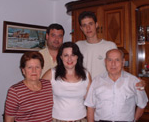 |
This is Manoli’s family. They are from Valencia, Spain. Manoli has a husband and his name’s Luis. Their house is in Valencia. Luis and Manoli have a son. His name’s Rubén and he’s 18. Rubén is a student at university. Rubén’s university is in Valencia. Manoli’s mother is Emilia . She’s 77. Manoli’s father is Felipe. He’s 78. Emilia and Felipe are Manoli’s parents. They have a house in Valencia. |
La ‘s posesiva
Manoli‘s family = La familia de Manoli
‘s se usa normalmente para expresar posesión.
Manoli’s mother = La madre de Manoli
– ¡Cuidado!. No lo confundas con la contracción de ‘is’.
His name‘s Rubén (name is) = Su nombre es Rubén.
He‘s 18 (he is 18) = (Él) Tiene 18 años.
– Pero:
Rubén’s university = La universidad de Rubén.
AYUDITA
family = familia
husband = marido
son = hijo
student = estudiante
mother = madre
father = padre
parents = padres
have = tienen
has = tiene
house = casa
_____________________________________________
Contesta las preguntas sobre el texto anterior.
|
1. Is Luis Manoli’s husband?
2. Is Rubén a teacher? 3. Where is Manoli’s house? 4. Where is Rubén’s university? 5. What’s Manoli’s father’s name? 6. What’s her mother’s name? 7. How old is Manoli’s father? 8. How old is her mother? |
|
______________________________________________
Craig’s family
Lee el texto
|
|
This is Craig’s family. They are from London, England.
Craig has a sister. Her name’s Stephanie and she’s 49. Craig’s mother is 73. Her name’s Frances. His father’s 72. His name’s Harry. They have a big house in Spain. |
|
|

Completa la siguiente tabla con la información del texto anterior sobre la familia de Craig.
| NAME | AGE | |||
| Craig’s mother | ||||
| Craig’s father | ||||
| Craig’s sister |
| ¿Has observado que el adjetivo (big) precede al nombre?
En inglés suele ser habitualmente así, mientras que en español es generalmente al revés.
|
_____________________________________________________
lee el texto.
My name’s Stephanie. I’m from London. I’m 49 and I’m a housewife.
My father’s name’s Harry. He’s 72. My mother’s name’s Frances, and she’s 73. Frances is Harry’s wife. They have a big house in Spain. Frances and Harry are my parents and I am their daughter. They have two children.
I have a brother. His name is Craig and he’s a teacher in Valencia. He’s 41. I’m Craig’s sister.
I’m married. My husband’s name is Terry and he has a good job.
AYUDITA
wife = mujer, esposa
parents = padres
sister = hermana
daughter = hija
children = niños
brother = hermano
husband = marido, esposo
good job= buen trabajo
Elige la palabra correcta para cada frase.
parents / children / brother / daughter / father / sister
mother / son / husband / wife
|
1. Frances is Harry’s
2. Craig is Stephanie’s 3. Terry is Stephanie’s 4. Frances is Stephanie’s 5. Craig is Harry’s 6. Stephanie is Craig’s 7. Stephanie and Craig are Frances and Harry’s 8. Frances and Harry are Craig and Stephanie’s 9. Stephanie is Frances and Harry’s 10. Harry is Craig’s |
__________________________________________________
EL VERVO » TO HAVE » (tener)
| I | have | a house
|
| He She It |
has | |
| We You They |
have |
Escribe las siguientes frases. Sigue el ejemplo
| 1. 2. 3. 4. 5. 6. 7. 8. |
Elige ‘has’ o ‘have’ en las siguientes frases siguiendo el ejemplo.
| Manoli a son. His name’s Rubén
1. My wife a good job.
2. I a computer. 3. We a house in the city. 4. They an American car. 5. My sister two dogs. 6. Craig a sister. 7. Our house five rooms. 8. They a book. 9. Her daughter three children. 10. We a new phone. |
|
_________________________________________________
THE ALPHABET
Las letras del alfabeto inglés y repitelas.
A B C D E F G H I J K L M N O P Q R S U V W X Y Z
| Letra | Fonética | Pronunciación |
| A | /eɪ/ | [ei] |
| B | /bi/ | [bi] |
| C | /si/ | [ci] |
| D | /di/ | [di] |
| E | /i/ | [i] |
| F | /ef/ | [ef] |
| G | /dʒi/ | [yi] |
| H | /eɪtʃ/ | [eich] |
| I | /aɪ/ | [ai] |
| J | /dʒeɪ/ | [jei] |
| K | /keɪ/ | [kei] |
| L | /el/ | [el] |
| M | /em/ | [em] |
| N | /en/ | [en] |
| O | /əʊ/ | [ou] |
| P | /pi/ | [pi] |
| Q | /kju/ | [kiu] |
| R | /ɑ(r)/ | [ar] |
| S | /es/ | [es] |
| T | /ti/ | [ti] |
| U | /ju/ | [iu] |
| V | /vi/ | [uvi] |
| W | /ˈdʌb(ə)l ju/ | [dabliu] |
| X | /eks/ | [ex] |
| Y | /waɪ/ | [uai] |
| Z | /zed/ | [set] |
A : Ant = hormiga, Aunt = tía, And = y
B: Beautiful = bonito, Beach = playa, Blue = azul
C : Cherry = cereza, Cloud = nube, Cat = gato
D: Dry = seco, Dog = perro,
E: End = fin, Elephant = elefante
F: Food = comida, Fish = pez, Fast = rápido
G: Good = bien, Glue = pegamento
H: Horse = caballo, Hug = abrazo
I: Indian = indio, Igloo = iglú
J: Journal= periódico, Jail = cárcel, Jam= mermelada
K: King = rey, Key = llave, Kiss = beso
L: Love = amor, Live = vida, Last = último
M: Mother = madre, Mouse = ratón, Married= casado
N: Night = noche, Nine = nueve, Nose = nariz
O: Open = abierto, Other = otro
P: Pink = rosa, Power = poder
Q: Queen = reina, Question = pregunta
R: Reed = rojo, Rice = arroz, Rute = ruta
S: Star = estrella, Spring = primavera, Sport = deporte
T: Time = tiempo, Table = mesa
U: Umbrella = paraguas, Under = debajo
V: Verb = verbo, Volcano= volcán
W: Word = palabra, World = mundo
X: X-ray = radiografía, Xylophone = xilófono
Y: Young = joven, Yesterday = ayer, Yes = sí
Z: Zero = cero, Zoo = zoológico
___________________________________________________
HOW DO YOU SELL IT? (como se escribe eso?)
|
‘Spell’ tiene principalmente el sentido de ‘deletrear’.
Como habrás visto, a diferencia del español, en inglés las palabras tienen generalmente una pronunciación diferente a su forma escrita. Por ello suele emplearse el recurso de deletrear las palabras (sobre todo apellidos, lugares geográficos y términos que puedan resultar desconocidos) para identificarlas con certeza. |
Escribe palabras en ingles
|
1.
2. 3. 4. 5. 6. 7. 8. 9. 10. |
||
|
|
Escribe el término equivalente en inglés de la siguiente relación de palabras. La primera letra ya está escrita para ayudarte.
| 1. esposa, mujer | ||||
| 2. hermano | ||||
| 3. esposo, marido | ||||
| 4. madre | ||||
| 5. hijo | ||||
| 6. hermana | ||||
| 7. hijos | ||||
| 8. padres | ||||
| 9. hija | ||||
| 10. padre |
|
PUNTO
El plural en inglés generalmente se forma añadiendo una ‘s’ al final de la palabra brother -> brothers (hermano / hermanos) daughter -> daughters (hija / hijas) |
Pero no siempre es así. En inglés, algunas palabras tienen un plural irregular.
wife -> wives (esposa / esposas)
son -> children (hijo / hijos)