
 This is Angeles. She‘s a dentist and she lives and works in Valencia, Spain. On Mondays and Wednesdays Angeles gets up at 7 o’clock and goes swimming. She has breakfast in a bar and goes shopping. She never gets up late. She usually listens to the radio and sometimes she reads the newspaper.
She has lunch at 2 o’clock and goes to work by bus in the afternoon. She has a car but she doesn’t drive to work.
Angeles gets home late, usually at 9 or 10 o’clock. She has dinner and she sometimes plays ‘spider’ on her computer. She usually goes to bed at 12 o’clock. Sometimes she reads a book in bed.
Lee el texto otra vez y busca los verbos. Escríbelos en el siguiente cuadro. Sigue los ejemplos.
|
|
______________________________________________________
lee el texto de nuevo utilizando el cuadro de ayuda para conocer el significado de las palabras difíciles.
|
This is Angeles. She’s a dentist and she lives and works in Valencia, Spain. On Mondays and Wednesdays Angeles gets up at 7 o’clock and goes swimming. She has breakfast in a bar and goes shopping. She never gets up late. She usually listens to the radio and sometimes she reads the newspaper. She has lunch at 2 o’clock and goes to work by bus in the afternoon. She has a car but she doesn’t drive to work. Angeles gets home late, usually at 9 or 10 o’clock. She has dinner and she sometimes plays ‘spider’ on her computer. She usually goes to bed at 12 o’clock. Sometimes she reads a book in bed. |
|
______________________________________________________
Las siguientes frases no son correctas. Corrígelas mirando el texto anterior. Sigue los ejemplos.
Ejemplos
|
Angeles has breakfast at home.
Angeles desayuna en casa. |
Angeles doesn’t have breakfast at home. She has breakfast in a bar.
Angeles no desayuna en casa. Ella desayuna en un bar. |
|
|
She drives to work
Ella conduce para ir al trabajo. |
She doesn’t drive to work. She goes to work by bus.
Ella no conduce para ir al trabajo. Va al trabajo en autobús. |
| => | Angeles works in Barcelona | |
| Angeles doesn’t in Barcelona. She in Valencia. | ||
| => | She goes swimming on Tuesdays and Thursdays | |
| She | ||
| => | She listens to the television | |
| => | She has lunch at 12 o’clock | |
| => | She goes to work by car | |
| => | She goes to work in the morning | |
| => | She plays ‘Tomb Raider’ on her computer | |
| => | She reads a magazine in bed (magazine=revista) | |
_____________________________________________________
Lee otra vez las respuestas del ejercicio anterior. Escúchalas y repítelas. Intenta imitar la entonación.
- Angeles doesn’t work in Barcelona. She works in Valencia.
- She doesn’t go swimming on Tuesdays and Thursdays. She goes swimming
- on Mondays and Wednesdays.
- She doesn’t listen to the television. She listens to the radio.
- She doesn’t have lunch at 12 o’clock. She has lunch at 2 o’clock.
- She doesn’t go to work by car. She goes to work by bus.
- She doesn’t go to work in the morning. She goes to work in the afternoon.
- She doesn’t play ‘Tomb Raider’ on her computer. She plays ‘Spider’ on her computer.
- She doesn’t read a magazine in bed. She reads a book.
____________________________________________________
PRESENT SIMPLE – Presente Indicativo
| Positivo + | Negativo – | |||
| I You He She We They |
work work works works work work |
don’t work don’t work doesn’t work doesn’t work don’t work don’t work |
| Preguntas con respuesta corta | Respuestas cortas |
¡Cuidado!
Yes, I do NO X yes, I work X |
||
| Does she speak English? Do we work on Saturday? Do they work on Saturday? Does he work on Saturday? |
No, she doesn’t. / Yes, she does. Yes we do. / No, we don’t. Yes they do. / No, they don’t. Yes he does. / No, he doesn’t. |
| Más preguntas | When?
What? Where? |
||
| What time does she have lunch? | ¿A qué hora come ella? | ||
| Where does she live? | ¿Dónde vive ella? | ||
| When does she go to work? | ¿Cuándo va al trabajo? | ||
| What does she read in bed? | ¿Qué lee ella en la cama? |
______________________________________________________
RECUERDA
- En las frases afirmativas del presente simple normalmente no se usa el auxiliar ‘do’ o ‘does’ delante del verbo. Sin embargo, la tercera persona añade una ‘s’.You live in Valencia. He lives in London. -> Tú vives en Valencia. Él vive en Londres
- En las preguntas y negaciones se utiliza el auxiliar ‘do’ / ‘don´t’ (‘does’ / ‘doesn´t’ para la tercera persona).Do you live in Valencia? / Does he live in London?
No, I don’t. / No, he doesn’t - Con el verbo ‘To be’ (ser, estar) no se utiliza el auxiliar ‘do’ / ‘does’Observa la diferencia:
Where does she live? / She lives in Valencia -> ¿Dónde vive ella? / Ella vive en Valencia
Where is she from? / She is from London -> ¿De dónde es ella? / Ella es de Londres
___________________________________________________
Never, usually y sometimes
I usually read the newspaper in the morning. / Normalmente leo el periódico por la mañana.
We sometimes listen to the radio. / A veces escuchamos la radio.
Lee las siguientes frases y escribe el adverbio en el sitio correcto (justo delante del verbo). Sigue el ejemplo.
Ej. I read the newspaper (never) I never read the newspaper.
| 1. I work on Sundays (never) | ||
| 2. He goes swimming on Saturdays. (sometimes) | ||
| 3. We have dinner at home. (usually) | ||
| 4. I go to work by bus. (never) | ||
| 5. She has lunch in a bar. (sometimes) | ||
| 6. I read in bed. (never) | ||
| 7. They go swimming in the morning (usually) | ||
| 8. I have breakfast in a bar (sometimes) | ||
| 9. I get up at 6 o’clock. (never) | ||
| 10. We go shopping on Saturdays. (usually) |
_____________________________________________________
Traduce las siguientes frases al español siguiendo el ejemplo.
Ej. I never work on Sundays -> Nunca trabajo los domingos.
| 1. He sometimes goes swimming on Saturdays. | ||
| 2. We usually have dinner at home. | ||
| 3. I never go to work by bus. | ||
| 4. She sometimes has lunch in a bar. | ||
| 5. I never read in bed. | ||
| 6. They usually go swimming in the morning. | ||
| 7. I sometimes have breakfast in a bar. | ||
| 8. I never get up at 6 o’clock in the morning. | ||
| 9. We usually go shopping on Saturdays. |
Relaciona las palabras del grupo A con las del grupo B. Sigue el ejemplo.
A |
B |
|
| 1. have | ||
| 2. drive | ||
| 3. play | ||
| 4. read | ||
| 5. get up | ||
| 6. listen |
____________________________________________________
Relaciona las palabras del grupo A con las del grupo B.
A |
B |
|
| 1. work | ||
| 2. speak | ||
| 3. go | ||
| 4. play | ||
| 5. have | ||
| 6. read |
______________________________________________________
Relaciona las preguntas con las respuestas. Sigue el ejemplo.
| A | B | |
| 1. What time do you get up? | ||
| 2. How old are you? | ||
| 3. Where do you live? | ||
| 4. What’s this in English? | ||
| 5. Who’s your teacher? | ||
| 6. How many brothers do you have? | ||
| 7. When do you go swimming? |
____________________________________________________
lee los siguientes adjetivos. Mira los dibujos.
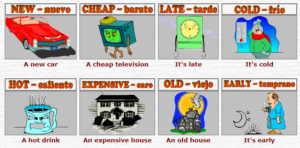
Escribe el adjetivo contrario. Sigue el ejemplo.
| expensive | |||
| cold | |||
| late | |||
| old |
Elige el adjetivo correcto en las siguientes frases. Sigue el ejemplo.
It’s usually in New York in December
|
1. 6 o’clock in the morning is
2. A Ferrari is a/an car. 3. In August Spain is very 4. My father is 78. He’s an/a man. 5. In Spain, people usually have a dinner. 6. The coffee in Paris is very 7. India is a country to visit. 8. My son has a/an computer. |
|
Elige la mejor palabra para hacer cada pregunta. Sigue el ejemplo.
is your name?
|
do you live?
are you?. time do you go to work? do you usually have lunch? does she read in bed? does your husband get home? do you do after work? brothers and sisters do you have? do you get up at 6 o’clock? music do you like? old are you? my new radio? |
|
||